FAQs

Industrial Stamping Press
From 25 to 630 Tons
-
General Questions
What stamping applications are suitable for different press tonnages (40T/50T/60T, etc.)?
What stamping applications are suitable for different press tonnages (40T/50T/60T, etc.)?
Smaller tonnages such as 40T and 50T are ideal for micro-precision parts like miniature terminals and electronic connectors. 60T-80T models are suitable for medium-sized components such as computer heat sinks that require both efficiency and accuracy. 80T, 125T, and 150T presses handle automotive metal parts, while 220T presses are capable of thick-walled components for heavy industrial applications.
How does the press maintain precision when stamping electronic components requiring micron-level accuracy?
How does the press maintain precision when stamping electronic components requiring micron-level accuracy?
The knuckle joint high-speed precision press features a stable mechanism and 2 guide posts with 8-way slide guiding, combined with servo die-height adjustment and a die-height memory system. These ensure precision and stability during high-speed operation, meeting the strict tolerances of electronic component stamping.
How do high-speed presses adapt to complex processes in automotive part manufacturing?
How do high-speed presses adapt to complex processes in automotive part manufacturing?
With a stroke range of 16 to 40 mm and speeds up to 1000 spm, the press performs multiple operations such as drawing, punching, and trimming within a short cycle time. This makes it highly efficient for multi-step automotive part forming that demands speed and precision simultaneously.
How is stability maintained during continuous high-speed production without losing accuracy over time?
How is stability maintained during continuous high-speed production without losing accuracy over time?
The press frame is constructed from high-rigidity materials and reinforced with a knuckle joint structure, ensuring minimal deformation under high-frequency impact. The 2 guide posts with 8-way slide guiding design maintain long-term precision and stable stamping operation during extended production runs.
What are the vibration and noise levels during operation?
What are the vibration and noise levels during operation?
The optimized knuckle linkage mechanism and balancing design, paired with a low-noise, backlash-free clutch and brake, significantly reduce vibration and noise, providing smoother and quieter operation even at high speeds.
What maintenance measures are recommended to ensure long-term stable performance?
What maintenance measures are recommended to ensure long-term stable performance?
Regular inspection and maintenance of the knuckle linkage, slide, and guiding components are essential. The lubrication and cooling systems should be serviced periodically, and the control system should be checked and upgraded as needed to maintain accuracy and ensure reliable long-term operation.
What types of parts can be processed with the DHS-30T/45T five-guide-post straight side high-speed precision press?
What types of parts can be processed with the DHS-30T/45T five-guide-post straight side high-speed precision press?
The five-guide-post straight side high-speed precision press is ideal for producing motor and electrical components such as rotors, stators, and transformer EI laminations. It is also suitable for metal accessories including buttons, zipper heads, and watch parts, as well as electronic and communication components such as LED brackets, connector terminals, contact springs, and heat sinks.
How does the press maintain precision and material integrity when stamping ultra-thin materials such as lithium battery foil?
How does the press maintain precision and material integrity when stamping ultra-thin materials such as lithium battery foil?
The side press features a single-piece gantry frame with guide posts and slide integrated as one precisely aligned unit to ensure rigidity and prevent deformation under load. Its forced lubrication system and dynamic balancing mechanism minimize thermal expansion and vibration, guaranteeing high precision and material integrity during ultra-thin foil stamping.
Can the press handle complex-shaped components like irregular electronic parts, and does it support efficient production?
Can the press handle complex-shaped components like irregular electronic parts, and does it support efficient production?
The straight side press supports multi-stage progressive dies and custom-shaped tooling, offering flexible die installation. Equipped with a high-precision die alignment system and capable of 200-800 strokes per minute, it delivers stable, high-speed stamping for complex components while reducing die change time and ensuring continuous production efficiency.
Is daily maintenance complicated, and what are the main tasks required for long-term stability?
Is daily maintenance complicated, and what are the main tasks required for long-term stability?
Routine maintenance is straightforward. It mainly includes cleaning and inspecting the five guide posts, checking and replenishing lubricating oil in the forced lubrication system, and verifying the sealing and positioning accuracy of the slide locking system. Regular cleaning of the frame and electrical components, along with tightening of key bolts, ensures stable and reliable long-term operation.
What types of applications are suitable for different tonnages of the MDH Series press (30–200 ton)?
What types of applications are suitable for different tonnages of the MDH Series press (30–200 ton)?
The 30-60 ton side presses are ideal for electronics, LED brackets, and miniature hardware components. Presses in the 80-120 ton range are suited for appliance and automotive parts such as small structural components, heat sinks, and motor rotors and stators. Larger 150-200 ton presses are designed for heavy-duty hardware and automotive chassis components, capable of handling large and high-strength stampings.
Compared with standard presses, what advantages does the six-guide-post structure provide in precision stamping?
Compared with standard presses, what advantages does the six-guide-post structure provide in precision stamping?
The six-guide-post design enhances guiding accuracy, motion stability, and resistance to off-center loads, while significantly reducing wear and thermal deformation. This ensures superior performance and reliability during long-term precision stamping operations.
What control system is used in the MDH press, and can operators monitor production status in real time?
What control system is used in the MDH press, and can operators monitor production status in real time?
All MDH presses feature a microcomputer-based human-machine interface with a high-visibility control panel. It provides real-time information on production count and machine operating status, allowing operators to monitor processes clearly without complex adjustments.
Can the MDH presses be integrated with other auxiliary equipment for automated production lines?
Can the MDH presses be integrated with other auxiliary equipment for automated production lines?
The presses can be connected with auxiliary equipment such as feeders, decoilers, straighteners, and scrap choppers. The decoiler supplies coiled raw material, the straightener improves material flatness, the feeder ensures continuous and precise feeding, and the scrap chopper automatically removes waste material, all working in coordination to form a complete automated stamping line.
Do auxiliary devices require special adaptation when setting up an automated line?
Do auxiliary devices require special adaptation when setting up an automated line?
No major modifications are needed. The MDH press includes standardized interfaces that are fully compatible with conventional feeders, decoilers, straighteners, and scrap choppers, ensuring smooth integration and reliable operation.
What industries are the DDL and DDH crank presses mainly used in?
What industries are the DDL and DDH crank presses mainly used in?
Both the DDL and DDH crank presses are widely used in the new energy vehicle, semiconductor, connector, LED, home appliance, consumer electronics, and industrial motor industries.
What are the application differences between different tonnage levels of the DDL and DDH presses?
What are the application differences between different tonnage levels of the DDL and DDH presses?
Smaller-tonnage presses such as DDL-125T and DDH-125T are suited for thin and small precision parts, while higher-tonnage models such as DDH-400T and DDH-630T are ideal for thicker and stronger components that require higher forming force.
The press body uses high-strength cast iron. What process ensures long-term stability after casting?
The press body uses high-strength cast iron. What process ensures long-term stability after casting?
After precise temperature-controlled tempering, the frame undergoes natural aging over an extended period to release internal stress. This process minimizes deformation caused by residual stress and enhances the structural stability of the frame for sustained precision performance.
How stable are the DDL and DDH presses when used in the new energy vehicle industry?
How stable are the DDL and DDH presses when used in the new energy vehicle industry?
Both series are designed with high-strength cast iron frames featuring high rigidity and low deformation. Equipped with a slide balancing system and vibration isolation mounts, these presses effectively reduce vibration and impact during operation, maintaining smooth, stable performance even under high-speed stamping conditions.
What is the pressing capacity and stroke speed range of the DDL crank press?
What is the pressing capacity and stroke speed range of the DDL crank press?
The DDL crank press offers a pressing capacity from 125 to 360 tons, with stroke speeds ranging from 100 to 500 strokes per minute, meeting a wide range of precision stamping requirements.
Can the crank press be adapted for larger metal components beyond its typical applications?
Can the crank press be adapted for larger metal components beyond its typical applications?
The DDL and DDH crank presses offer a broad range of pressing capacity and stroke speed and can be flexibly integrated with various auxiliary devices. As long as the workpiece size falls within the press’s stroke and table capacity, adjustments and compatible configurations allow feasible adaptation for larger parts.
What auxiliary equipment can the DDL crank press be combined with to form a metal stamping line?
What auxiliary equipment can the DDL crank press be combined with to form a metal stamping line?
The DDL crank press can be integrated with feeders, decoilers, straighteners, and scrap choppers to form a fully automated metal stamping line, improving efficiency and reducing manual handling.
What certifications are available for the straight side crank presses?
What certifications are available for the straight side crank presses?
Our metal stamping presses are certified with CE, KC (Korea Certification), ISO 9001, and ISO 14001, ensuring compliance with international quality and safety standards.
Can the metal stamping press be customized?
Can the metal stamping press be customized?
The metal stamping presses can be customized to meet specific requirements such as special stroke lengths or customized worktable dimensions according to customer needs.
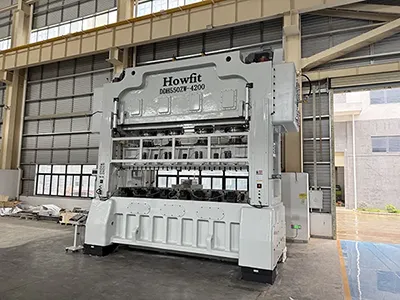
What industries is the 400-ton 3 guide post, 8-way roller slide guiding high-speed precision press (DDH400ZW-3700) suitable for?
What industries is the 400-ton 3 guide post, 8-way roller slide guiding high-speed precision press (DDH400ZW-3700) suitable for?
With its large tonnage output, high guiding precision from the 8-way roller slide system, and high-speed performance, this press is ideal for producing large and high-strength structural components in the automotive industry, battery trays and covers in the new energy sector, and heavy-duty metal parts in sheet metal fabrication.
Can the 400-ton press handle complex large-size stamping applications?
Can the 400-ton press handle complex large-size stamping applications?
With a pressing capacity of 4000 kN, an extra-wide working table of 3700×1200 mm, and a stroke speed of 80-200 spm, the high-speed metal stamping press easily accommodates large and intricate components such as motor rotors and stators, or large home appliance metal parts, providing ample processing space and reliable load-bearing performance.
Is maintenance of the 8-way roller slide guiding system complicated?
Is maintenance of the 8-way roller slide guiding system complicated?
The 8-way roller slide guiding system is designed for ease of maintenance. It features a simple disassembly structure and only requires regular lubrication to maintain long-term precision and smooth operation.
How does the press maintain stability and manage heat during continuous high-speed operation?
How does the press maintain stability and manage heat during continuous high-speed operation?
The combined guiding system of the central 3 guide posts and 8-way slide guiding structure enhances slide motion stability and minimizes eccentric load deviation. A high-rigidity frame design suppresses vibration during high-speed operation, while a forced circulation oil-cooling system efficiently dissipates heat from critical components such as the guide rails and crankshaft, ensuring stable performance even under extended production cycles.
Which industries and components are best suited for the 550-ton 4 guide post, 8-way roller slide guiding high-speed precision press?
Which industries and components are best suited for the 550-ton 4 guide post, 8-way roller slide guiding high-speed precision press?
This straight slide press is designed for applications in the new energy vehicle sector (such as large battery trays, body side panels, and roof structures), heavy machinery manufacturing (including thick-walled flanges and large gear blanks), and construction equipment (like cab frames and hydraulic cylinder shells). It is capable of stamping high-strength steel and aluminum alloy sheets with thicknesses ranging from 4 to 8 mm.
What core advantages does the 4 guide post and 8-way roller slide guiding structure provide in stamping operations?
What core advantages does the 4 guide post and 8-way roller slide guiding structure provide in stamping operations?
The four symmetrically distributed guide posts effectively counteract lateral forces generated during 550-ton stamping, while the 8-way guiding system (with clearance ≤0.005 mm) ensures slide linearity within ≤0.02 mm/m. This design prevents slide tilting and dimensional deviation during thick-sheet stamping, reduces uneven die wear, and extends die life by more than 30%.
How does the straight side press maintain accuracy and stability during continuous high-speed stamping at up to 200 strokes per minute?
How does the straight side press maintain accuracy and stability during continuous high-speed stamping at up to 200 strokes per minute?
The guiding system with central four guide posts and 8-way roller slide guiding ensures precise slide motion and neutralizes eccentric load during high-speed operation. A high-rigidity frame minimizes vibration, while a real-time dynamic precision monitoring system automatically corrects any slide displacement errors. In addition, a forced circulation oil-cooling system efficiently controls thermal deformation of critical components, maintaining stable accuracy throughout long production runs.
What advantages does the 3-guide post structure of the C-frame press provide compared to standard guide systems?
What advantages does the 3-guide post structure of the C-frame press provide compared to standard guide systems?
The 3-guide post design features a symmetrical layout with precision ball bearings, improving slide linearity and effectively counteracting lateral forces during stamping. This minimizes guide clearance errors and prevents dimensional deviations in stamped parts.
Can the HC-16T press maintain precision and high-frequency production of electronic connector terminals with a thickness of 0.05-0.5 mm?
Can the HC-16T press maintain precision and high-frequency production of electronic connector terminals with a thickness of 0.05-0.5 mm?
The HC-16T press delivers 16 tons of pressing force, a stroke range of 20-30 mm, and a maximum speed of 800 spm. Its dual side guide posts and central column maintain precision within ±0.005 mm, ensuring consistent high-frequency stamping for ultra-thin electronic terminals.
Can the metal stamping press maintain batch consistency when running continuously for 24 hours to stamp 1 mm-thick air conditioner fins?
Can the metal stamping press maintain batch consistency when running continuously for 24 hours to stamp 1 mm-thick air conditioner fins?
The frame is built from high-strength cast iron and fully stress-relieved, maintaining a deformation tolerance within 0.01 mm during continuous operation. This ensures consistent batch precision even under 24-hour production cycles.
Can the control interface and fault monitoring system reduce operational difficulty and maintenance costs for inexperienced operators?
Can the control interface and fault monitoring system reduce operational difficulty and maintenance costs for inexperienced operators?
The human–machine interface enables digital parameter setup, while the real-time fault monitoring system identifies and alerts the cause of errors immediately. This reduces operator mistakes by up to 60% and minimizes maintenance downtime by around 40%, improving overall efficiency and cost control.
Is the press capable of handling large, multi-stage tooling for metal hardware stamping?
Is the press capable of handling large, multi-stage tooling for metal hardware stamping?
The 85T C-frame press enhances its standard slider structure with fixed guide posts on both sides, greatly improving resistance to off-center loads and reducing uneven die wear. Its 1100×680 mm large worktable easily accommodates long, complex tooling for hardware component stamping.
How efficient is die adjustment when frequently changing can lid molds with a shut height of 310-350 mm?
How efficient is die adjustment when frequently changing can lid molds with a shut height of 310-350 mm?
With an adjustable shut height range of 305-365 mm (50 mm slide adjustment), the metal stamping press features an electric die adjustment system with height display and hydraulic locking. This setup allows fast and convenient die changeovers, minimizing downtime during frequent mold replacement.
Is the control interface and fault monitoring system easy to use for less experienced operators?
Is the control interface and fault monitoring system easy to use for less experienced operators?
The 85T metal stamping press adopts a microcomputer-based human–machine interface for digital parameter input (such as speed and die height), with a real-time fault display on screen. The system is intuitive and easy to operate, helping reduce user errors and simplifying operation training.
How well does the press integrate with feeding, leveling, and other auxiliary equipment for automated lines?
How well does the press integrate with feeding, leveling, and other auxiliary equipment for automated lines?
The 85T C-frame press (5 guide posts) can be seamlessly integrated with feeders, straighteners, decoilers, and scrap choppers. Its 18.5 kW main motor provides sufficient power to synchronize operation with auxiliary devices, enabling smooth and efficient automated stamping line setup.
Can the fault monitoring system quickly locate issues such as motor abnormalities to reduce downtime?
Can the fault monitoring system quickly locate issues such as motor abnormalities to reduce downtime?
The metal stamping equipment’s fault monitoring system continuously tracks machine status, including the 18.5 kW main motor. In the event of an error, it identifies and displays the exact fault source on screen, allowing maintenance staff to locate and resolve issues quickly, minimizing production interruptions.
Can the press frame maintain precision stability during 24-hour continuous stamping of hardware components?
Can the press frame maintain precision stability during 24-hour continuous stamping of hardware components?
The 65E C-frame press features a high-strength cast iron frame that has been fully stress-relieved to ensure long-term structural stability. This design prevents deformation during continuous operation, maintaining consistent batch accuracy throughout extended production cycles.
How does the optional counterbalance system improve accuracy and workshop conditions during high-speed stamping (e.g., 300 spm)?
How does the optional counterbalance system improve accuracy and workshop conditions during high-speed stamping (e.g., 300 spm)?
When equipped with the counterbalance system, the metal stamping press significantly reduces vibration at speeds between 180-350 spm. This enhances stamping precision, maintaining dimensional tolerance within ±0.01 mm for hardware parts, while lowering noise levels and minimizing interference with surrounding equipment.
Can the 180×1000 mm scrap outlet handle stainless steel parts with 2 mm thickness smoothly?
Can the 180×1000 mm scrap outlet handle stainless steel parts with 2 mm thickness smoothly?
The HCW-65E metal stamping press is equipped with a large 180×1000 mm scrap outlet that enables efficient discharge of 2 mm thick stainless steel stamping waste. This prevents clogging or material buildup, ensuring smooth and uninterrupted high-speed production.
Looking for high-speed mechanical stamping presses?Talk to our experts.
Contact Us




Main Products